

Table of Contents
A brief introduction of vitamins vs. Herbal supplements
Dietary supplements have become an integral part of the routines of millions of individuals in today’s world, which places a strong emphasis on health. Supplements are frequently considered to be a convenient answer, regardless of whether the objective is to strengthen the immune system, enhance energy levels, support digestion, or maintain general wellness. Plant-based supplements and vitamins are two of the possibilities that are discussed the most frequently.
Many individuals continue to be confused about the differences between vitamins and plant-based supplements, how each one functions in the body, and which alternative is better suited to meet particular health requirements, despite the fact that both are commonly utilized. A misunderstanding of these distinctions can result in expectations that are not practical, incorrect usage, or even worries about safety.
The purpose of this tutorial is to provide you with a straightforward, well-balanced, and evidence-based approach to gaining a comprehensive understanding of the principles of vitamin supplements and plant-based supplements. By the time you reach the conclusion of this article, you will have acquired the knowledge necessary to make decisions that are more informed and in line with your particular health goals and your long-term approach to natural health.
What exactly are vitamins, then?

Vitamins are chemical substances that are necessary to the human body and are required in very small levels for the body to function properly. Vitamins, in contrast to macronutrients like carbs, proteins, and lipids, do not contribute to the production of energy. Instead, they are involved in the metabolism, immune system, growth, and repair of cells, all of which are extremely important.
As a result of the fact that the human body is unable to create the majority of vitamins on its own, it is necessary to receive them through either the diet or the use of vitamin supplements.
Various Categories of Vitamins
Vitamins can be divided into two primary categories, which are as follows:
1. Vitamins that are soluble in water
It is not possible for these vitamins to be stored in the body for extended periods of time because they dissolve in water.
- The vitamin C
- The vitamins that make up the B-complex (B1, B2, B3, B6, B12, folate, and biotin)
Excess amounts are often eliminated through the urine, which lowers the danger of toxicity but raises the requirement for consistent consumption.
2. Vitamins that are not soluble in fat
These vitamins are stored in the tissues of the body and disintegrate in fat.
- Vitamin A (FA)
- Vitamin D (VOC)
- Antioxidant vitamin E
- The vitamin K
Due to the fact that they build up in the body, an excessive intake has the potential to produce toxicity if it is ingested in an incorrect manner.
What Exactly Are Vitamin Supplements?
Vitamin supplements are manufactured goods that are designed to supply vitamins in doses that have been measured. They are available in a wide range of formats, including as pills, capsules, powders, liquids, and gummies.
The Reasons Why People Take Vitamin Supplements
People could use vitamin supplements for a variety of reasons, including the following:
- Deficiencies in essential nutrients
- Diets that are restricted or limited
- Increased dietary requirements (due to pregnancy, aging, or strenuous physical activity)
- Advice from medical professionals or preventative care
Vitamin supplements are standardized, which means that the dosage and the contents of the supplement are both clearly specified on the label. When compared to many natural goods, this makes it much simpler to test and manage them.
What Exactly Are Herbal Supplements?
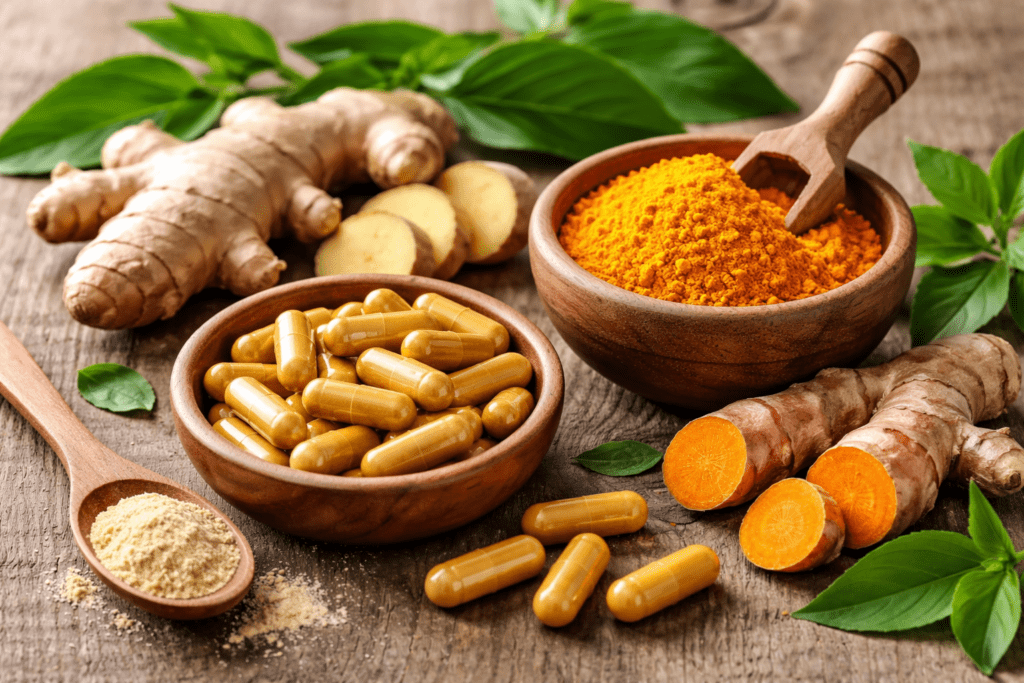
Plant-based supplements are products that are derived from plants or parts of plants, such as leaves, roots, seeds, bark, flowers, or extracts. They have been utilized for ages in the traditional medical systems of a variety of different countries.
Turmeric, ashwagandha, ginseng, garlic, ginger, echinacea, and peppermint are some examples of common herbs.
Plant-based supplements, in contrast to vitamins, are not regarded as essential nutrients. Instead, they are frequently utilized to support particular body systems or to improve overall wellness.
The Traditional Origins of Plant-based supplements
Traditional medical practices, such as the following, have a strong foundation in plant-based supplements:
- Ayurvedic medicine
- TCM stands for traditional Chinese medicine.
- Healing techniques indigenous to Africa and other African countries
- The herbalism of Europe
Instead of focusing solely on nutrient consumption, these systems place an emphasis on maintaining a healthy lifestyle, maintaining balance, and promoting long-term wellness. This ideology is highly congruent with contemporary natural health movements that place an emphasis on overall well-being.
The Most Important Distinctions Between Vitamins and Plant-based supplements
Having an understanding of the differences between plant-based supplements and vitamins might assist you in selecting the most appropriate solution for your specific health requirements.
1. The Aim and the Function
Vitamins are necessary for the body to perform fundamental processes, including the metabolism of energy, the defense of the immune system, the maintenance of bone health, and the operation of nerves.
Instead of being utilized to avoid deficiencies, plant-based supplements are typically used to assist particular systems, such as digestion, the stress response, and inflammation.
2. The process of standardization
Vitamin supplements are formulated with exact and calculated amounts.
In plant-based supplements, the quality of the plant, the growing circumstances, the extraction processes, and the formulation can all have an impact on the product.
3. The evidence from scientific research
Extensive research has been conducted on vitamins, and the symptoms of vitamin deficiencies have been thoroughly recorded.
There are varied degrees of scientific evidence for plant-based supplements; some are supported by extensive study, while others rely more on traditional methods of use.
4. The Rapidity of the Action
Vitamins frequently fix deficits in a progressive manner.
Depending on the plant and the formulation, plant-based supplements could have more obvious benefits in the short term.
Vitamins and their many advantages
The maintenance of one’s health is largely dependent on the use of vitamins. These are some of the most important advantages:
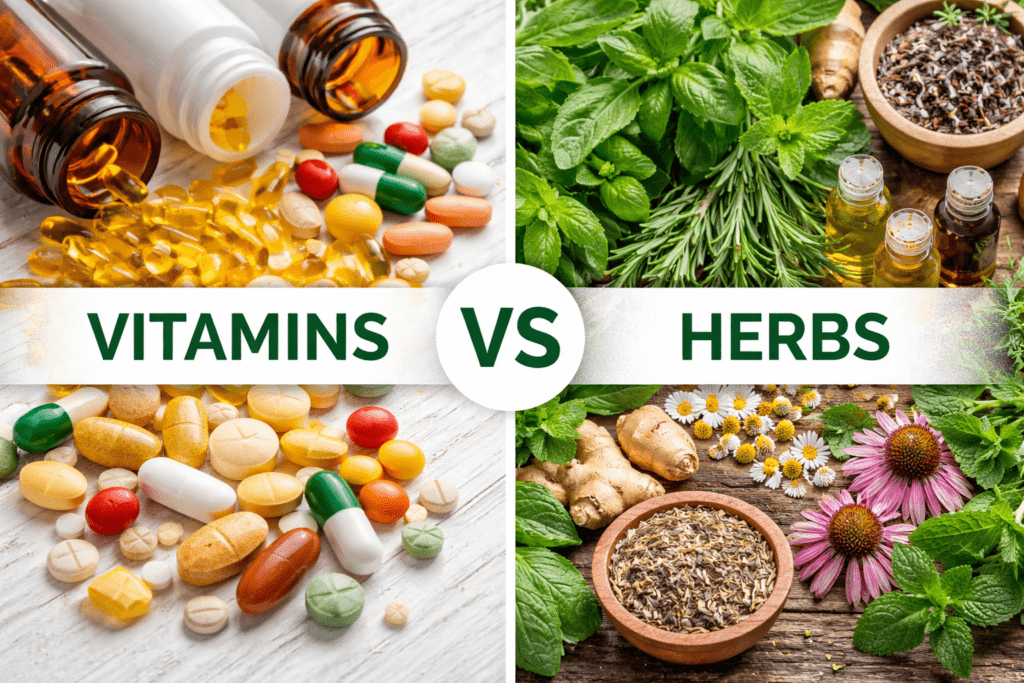
- Facilitating the functioning of the immune system
- Improving the production of energy
- In order to promote healthy skin, hair, and vision
- Providing support for bone density and muscle function
- Preserving the health of the nerve system and the cognitive system
Taking vitamin supplements in a responsible manner can help bridge nutritional gaps, but they should not be used in place of a diet that is balanced.
Advantages of Taking Plant-based supplements
Many people place a high value on plant-based supplements because of the wider, system-level advantages they offer, such as:
- Facilitating the management of stress and relaxation
- Facilitating the comfort of the digestive system
- Contributing to the maintenance of immunological balance
- Contributing to the health of the joints and mobility
- Improving the quality of sleep and fostering mental clarity
Plant-based supplements are preferred by a lot of people since they feel more in line with natural wellness practices.
Concerns Regarding the Safety of Both
Protection of Vitamins
- Consuming an excessive amount of fat-soluble vitamins may result in toxicity.
- It is only recommended that high doses be taken under the supervision of a trained specialist.
- There is no guarantee that more is always better.
The Safety of Plant-based supplements
- There is the potential for herbal remedies to interact with pharmaceuticals.
- Not all herbs are suitable for use over an extended period of time.
- There is a big difference between brands in terms of quality and purity.
Both forms of dietary supplements are to be selected with caution and utilized in a responsible manner.
Which Is Better: Vitamins or Plant-Based Supplements?
It is not possible to provide a universal response. Individual considerations such as the following can determine which option is superior:
- Habits regarding one’s diet
- Both age and lifestyle are factors.
- aims in terms of health
- Existing conditions of the medical system
- The individual’s choice for either natural or tailored assistance
In many instances, vitamins and plant-based supplements can be complementary to one another if they are utilized in a sensible manner.
Is it possible to use plant-based supplements and vitamin supplements at the same time?
Yes, but with extreme caution. There are certain combinations that function well together, while others may cause problems with absorption or effectiveness.
Among the general best practices are the following:
- It is important to avoid unnecessary overlapping of functions.
- Ensure that you adhere to the appropriate dosages.
- For individualized direction, it is recommended that you seek the advice of a certified healthcare practitioner.
Instructions on How to Select High-Quality Supplements

When selecting either plant-based supplements or vitamins, it is important to search for the following:
- Labelling that is open and honest
- Detailed lists of the ingredients
- Testing or quality certifications conducted by a third party
- Claims about health that are grounded on reality (avoid making miracle promises).
- Conformity with the regulatory criteria of the local government
Effectiveness and safety are both supported by responsible selection.
A Balanced Perspective on Diet versus Supplements
It is important to note that supplements should not substitute a healthy lifestyle. The cornerstone of well-being continues to be a diet that is rich in nutrients, proper water, physical activity, and effective management of stress.
Vitamins are helpful in addressing deficiencies, and plant-based supplements may improve general balance. Both have the potential to play supportive roles in long-term natural health methods if they are used appropriately.
Some Misconceptions and Myths That Are Widespread
- The adage “natural always means safe” is not always accurate.
- The benefits of vitamins are gradual, despite the assumption that vitamins deliver quick results.
- “Plant-based supplements cure diseases”—while they do enhance health, they are not cures for diseases.
Realistic expectations can be avoided by having a thorough understanding of these distinctions.
Variations in Regulations Around the World
The regulations governing supplements differ from country to country. Supplements are considered to be foods in some countries, while in others they are considered to be health products. Labeling standards, quality control, and health claims are all impacted as a result of this.
Consumers should always make purchases from reputable brands that adhere to the rules set forth by regulatory agencies.
Which Individuals Should Exercise Extra Caution?
Certain groups ought to exert an increased degree of caution:
- persons who are either pregnant or breastfeeding
- Individuals that suffer from persistent conditions
- People who are currently taking drugs prescribed by a doctor
- People of advanced age
In situations like these, the advice of a professional is very crucial.
Concluding remarks
Although vitamins and plant-based supplements both play significant roles in contemporary wellness routines, they do so for distinct reasons. Vitamins are important nutrients that support basic biological functions, whereas plant-based supplements draw from traditional practices to provide balance and system-level support. Vitamins are vital nutrients.
If you have a fundamental understanding, you will be able to make judgments that are more intelligent, safer, and better tailored to your own needs. Instead of picking one over the other, many people discover that the most effective way to achieve long-term health is to combine a number of different approaches in a way that is intelligent and based on education and moderation.
Always keep in mind that supplements are tools, not fast cuts. To achieve true well-being, you must first make choices based on accurate information, maintain consistency, and show respect for the specific requirements of your body.